The Core Doctordle Rules
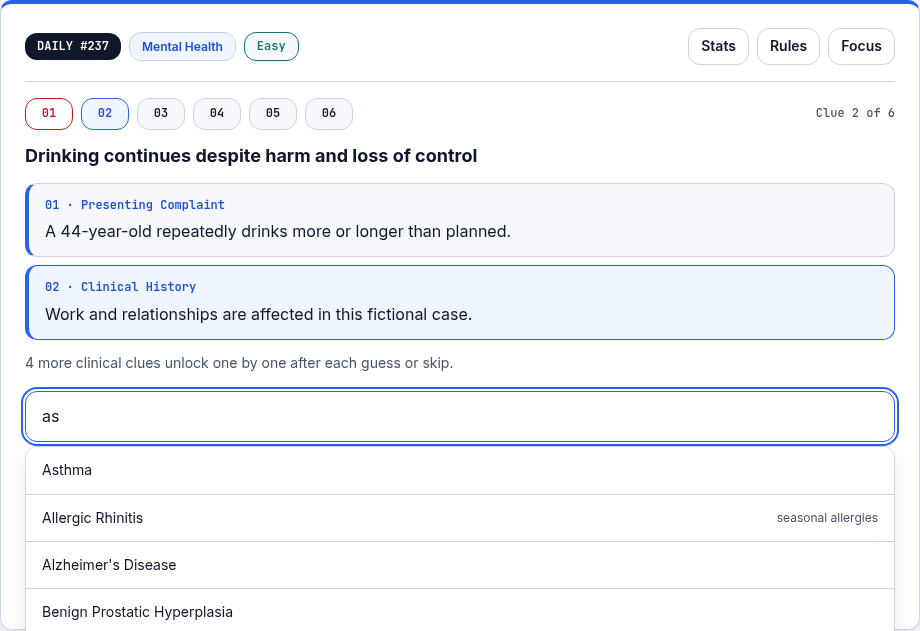
Learning how to play Doctordle takes less than thirty seconds. Every puzzle presents a fictional teaching patient case with a single target diagnosis. You have six total chances to identify that condition:
- Read Clue 01 (Presenting Complaint). Every case starts with one concise patient vignette showing age, main symptom, and clinical setting.
- Type a diagnosis or skip for more data. Start typing in the diagnosis box to filter all 160 conditions and accepted aliases. Pick a suggestion with your keyboard arrows (
↑/↓+Enter) or tap it directly on mobile, then click Submit Diagnosis. - Unlock the next clue. Each incorrect guess—or each click of Next Clue (Skip)—reveals the next stage of the diagnostic chart until all six clues are visible.
- Review the MedlinePlus explanation. When you guess correctly (or after your sixth attempt), Doctordle reveals the answer, accepted aliases, a plain-English educational summary, and a direct link to the matching MedlinePlus.gov topic page.
Understanding the 6-Clue Clinical Ladder
Every case in Doctordle follows a deliberate six-step progression modeled on a standard clinical workup:
- 01 · Presenting Complaint: Age, chief symptom, and onset context.
- 02 · Clinical History: Symptom timing, triggers, risk factors, or exposures.
- 03 · Physical Exam: Key bedside examination findings.
- 04 · Labs & Workup: Diagnostic test clues, imaging descriptions, or functional measures.
- 05 · Clinical Pattern: Underlying mechanism or organ-system summary.
- 06 · Final Confirming Clue: A high-yield hallmark or defining management anchor.
How Scoring, Streaks, and Share Grids Work
Your score is written as N/6 (such as 2/6 if you solved on Clue 2, or X/6 if the diagnosis was revealed after Clue 6). Doctordle keeps two separate stat tracks inside the Stats dialog:
- Daily Mode Stats: Tracks every Daily Case you finish, including total played, win percentage, current streak, best streak, and your 1/6–6/6 guess distribution. Daily cases also show the live community solve distribution once you complete today's puzzle.
- Unlimited & Archive Stats: Tracks your practice streak and total unique cases solved across Doctordle Unlimited and the Doctordle Archive without risking your daily streak.
When you click Copy Result Grid, Doctordle copies a clean, spoiler-free message you can paste into group chats or study channels:
Doctordle #237 3/6🩺🟨🟨🟩⬜⬜⬜https://doctordle.app/
Five Practical Clinical Reasoning Habits
- Read the specialty and difficulty pills first. Knowing a vignette sits in Neurology & Sleep or Gastroenterology & Liver focuses your mental differential immediately.
- Separate acute from chronic on Clue 1–2. Sudden fever and focal findings point toward infection or acute events; months of gradual fatigue or episodic triggers point elsewhere.
- Use autocomplete to scan synonyms. Typing part of a symptom-linked condition or organ name helps recall the exact clinical phrasing accepted in the bank.
- Don't fear skipping Clue 1. If Clue 1 could fit six different conditions, clicking Next Clue to inspect Clue 2 history is often smarter than throwing a blind guess.
- Learn from the post-game MedlinePlus link. Each explanation clarifies which clues were classic teaching hallmarks—and reminds players that fictional puzzles never replace real clinical evaluation.
Ready to put the rules into practice? Head to today's Doctordle Daily Case or sharpen your reflexes in Doctordle Unlimited.