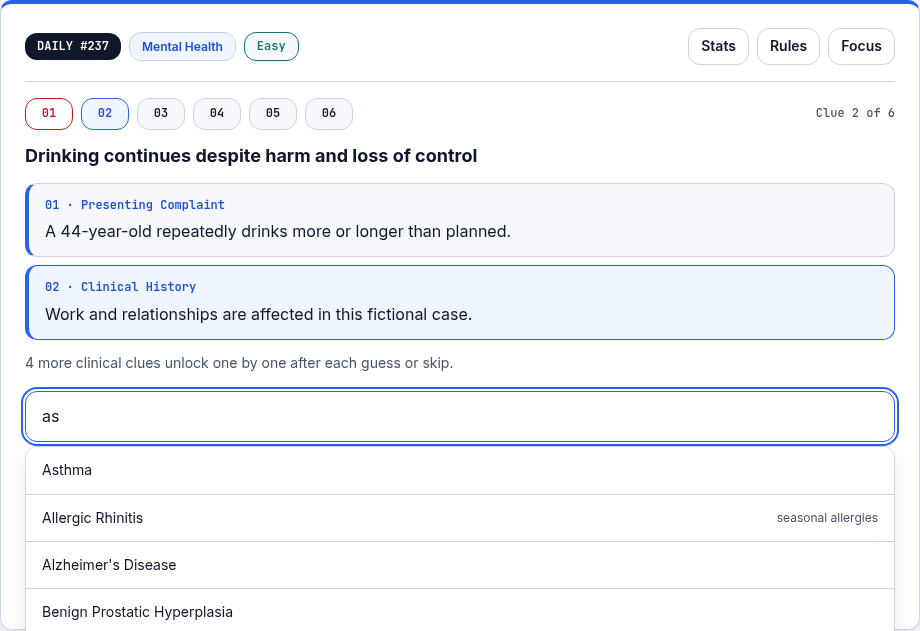
A 5-Minute No-Login Clinical Reasoning Warm-Up
Medical, nursing, physician-assistant, and pre-med students often want a quick daily diagnosis puzzle like Wordle that reinforces structured clinical thinking rather than random trivia—and works immediately on a phone or laptop without forcing account signups. Doctordle (doctordle.app) gives you one shared Daily Case at 00:00 UTC plus 160 curated cases across 13 medical specialties in Doctordle Unlimited and the Case Archive, all free in your browser.
To be transparent about scope: Doctordle is a lightweight educational pattern-recognition game, not a substitute for comprehensive board-exam Qbanks (such as UWorld or AMBOSS) or real bedside training. Its strength is low-friction daily retrieval—forcing your brain to generate a differential before seeing lab confirmation.
The 6-Clue Bedside Reasoning Workflow
Rather than typing a single guess on Clue 1 and hoping for luck, treat each Doctordle puzzle like a compressed clinical encounter:
- Clue 01 (Presenting Complaint) — Frame the Problem Representation: Note age, acuity, and chief symptom, plus the specialty badge at the top of the chart. Name three plausible diagnoses in your head before touching the input box.
- Clue 02 (Clinical History) — Separate Acute, Episodic, and Chronic: Use onset, exposures, and aggravating/relieving factors to cut your differential in half. If two conditions still look equally likely, press Next Clue (Skip) instead of burning a guess blindly.
- Clue 03 (Physical Exam) — Test Your Top Hypothesis: Look for classic localizing signs (focal crackles, asymmetric calf swelling, rash distribution, cranial-nerve or joint findings) that confirm one branch and rule out mimics.
- Clue 04 (Labs & Workup) — Anchor on Objective Data: Interpret the described lab markers, spirometry/ECG/ultrasound clues, or screening results. Most Medium and Hard cases become cleanly solvable here.
- Clue 05 & 06 (Clinical Pattern & Confirming Clue) — Lock In & Review: If a case reaches Clue 5 or 6, use the reveal screen's MedlinePlus.gov topic link to review why the hallmark clues pointed to that condition.
High-Yield Organ-System Clue Framework
Across our 160-case library, most diagnostic pivots happen between Clue 2 and Clue 4. Here is how to orient quickly across the largest specialty blocks on doctordle.app:
| Specialty Block (Cases) | Key Clue 1–2 Pivots | High-Yield Clue 3–4 Separators |
|---|---|---|
| Infectious Disease (23) | Fever onset, sick contacts, tick/vector or travel exposure, cough vs. rash | Focal exam findings, meningeal signs, rapid antigen/serology, culture or imaging cues |
| Neurology & Sleep (21) | Headache character, episodic vs. progressive weakness, tremor, seizures, sleep disruption | Focal neurologic deficits, reflexes, EEG/MRI descriptions, or sleep-study hallmarks |
| Oncology & Hematology (20) | Unexplained weight loss, fatigue, bruising/bleeding, night sweats, or painless masses | Blood counts, smear/marrow cues, lymphadenopathy, biopsy or staging clues |
| Gastroenterology & Liver (17) | Post-meal pain, reflux, chronic diarrhea, dysphagia, or jaundice | Localized tenderness, liver panel patterns, malabsorption markers, endoscopy/biopsy clues |
| Musculoskeletal & Immune (14) | Morning stiffness, joint symmetry, allergic triggers, or systemic rash/fatigue | Joint swelling vs. mechanical wear, inflammatory markers, autoantibody clues |
| Urology & Reproductive (14) | Flank pain, urinary frequency/burning, hematuria, pelvic pain, or pregnancy context | Urinalysis clues, kidney-function patterns, ultrasound findings |
| Cardiology & Vascular (11) | Exertional chest pressure, orthopnea, palpitations, or unilateral leg swelling | Pulse rhythm, blood pressure/lipid readings, edema, ECG/troponin or vascular ultrasound |
What Doctordle (doctordle.app) Covers—and What It Doesn't
Students comparing daily medical diagnosis games often ask what makes doctordle.app different from login-gated portals or full exam platforms:
- Zero account friction: Plays instantly on mobile Chrome/Safari and desktop browsers with no signup, no email capture, and no paywall—helpful when another medical Wordle site requires registration.
- Structured 160-case bank: Includes 65 Easy foundational cases, 81 Medium differential cases, and 14 Hard cases with alias-aware autocomplete (so valid clinical synonyms count instead of penalizing phrasing).
- Targeted specialty & archive modes: Switch from the Daily Case into Doctordle Unlimited, Cardiology Doctordle, or the spoiler-free Doctordle Archive (
?case=Nlinks make it easy to send the exact same vignette to a study group). - Transparent boundaries: Doctordle does not include visual ECG strips, CT/X-ray image sliders, timed 40-question USMLE blocks, or spaced-repetition Anki exports. For full board prep, pair your 5-minute Doctordle warm-up with your primary question bank and clinical guidelines.
Start a 5-Minute Study Session
- Warm up with today's shared puzzle: Play the Doctordle Daily Case
- Drill one organ system: Open Doctordle Unlimited or launch Cardiology Doctordle
- Challenge a classmate with a specific case number: Browse the Spoiler-Free Case Archive
- Review exact scoring & alias rules: How to Play Doctordle
Educational Disclaimer: All puzzles on
doctordle.appare fictional teaching vignettes for entertainment and clinical vocabulary review only. Never use game content for real patient triage, diagnosis, or treatment.